How Technology Can Enable The Consumer Industry Regain Its Mojo

The consumer products industry is under immense pressure with companies struggling to keep up with dramatic shifts in consumption patterns, including what people buy and how they purchase it. The SAP IKEX Roundtable invites senior leaders from the Retail and Consumer Industry for a freewheeling discussion on the key themes that are affecting the industry
Intro: The $5 Trillion Opportunity
With the Indian economy galloping towards the $5 Trillion milestone, the opportunities for the Consumer & Retail Industry are tremendous… (Don’t miss this growth wave)
Talking points - The growth opportunities for the consumer industry, staving off competition, scaling up operations and increasing consumer delight
Talk about the IKEX Roundtable and the discussion with senior leaders from the CPG industry. The points they discussed were -
- Challenges affecting the CPG industry (include pointers from https://docs.google.com/document/d/1rKtus892M43tjLkb9E-PDPqfqgVCkU8bg5ssBJ5MhuE/edit?usp=sharing)
- Overcoming challenges - Need for tech solutions to increase profitability, productivity & Customer experience (with competition increasing, customers being more demanding and input costs increasing, the only way to make profit is through improving the supply chain)
- Theme 4 (How is the consumer industry Rethinking supply chain) and include graphic from theme 2
- Conclude with Theme 2 & 5


Theme 1: Headwinds affecting the Consumer & Retail industry
(Highlight the pressures faced by the industry due to changing consumer behavior, ESG goals, competition, emerging sales channels (digital, ecommerce, omnichannel) supply chain disruptions, etc.)
Locked-down consumers have turned to online shopping for everything from healthcare supplies to home décor—and many have quickly grown accustomed to next-day delivery and on-demand customer service, intensifying the strain on pandemic stricken businesses that cannot meet these expectations as reliably as they normally might. This sudden boom in e-commerce is stress-testing relationships across the consumer products ecosystem, exposing weaknesses in the supply chain, and highlighting the need for digital transformation.
A cohesive, flexible approach to management is one answer to these challenges. Consumer products executives must treat their web of relationships within and beyond the organizational firewall as a unified entity that operates smoothly, dynamically, and as part of a cohesive strategy. That means using digital, data-driven technologies to understand interdependencies between parts of the business that have traditionally been siloed, like logistics and customer service or human resources and accounting—then applying those insights to respond dynamically to consumer demands and marketplace changes.
Theme 2: Key transformational shifts impacting the Retail Industry
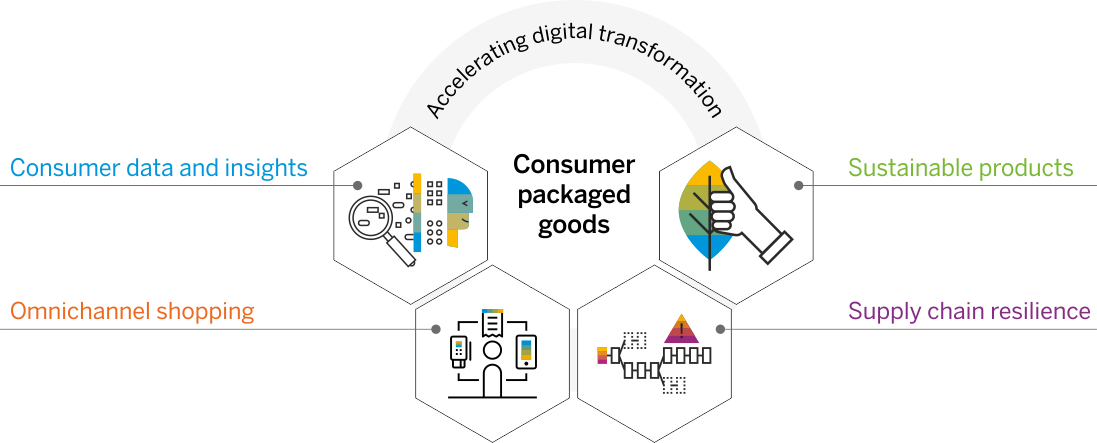
Accelerating digital transformation in CPG
Transforming consumer packaged goods (CPG) is more than adopting the latest direct-to-consumer models. It’s about using new technology – Internet of Things (IoT) and AI – to revolutionize internal processes and maximize speed and scalability.
Theme 3: The Strategies Currently deployed by consumer & retail sector
(Here we cover some of the key strategies mentioned by the different industry leaders.)
Talking points:
- How Data Analytics is shaping Business Strategy for Consumer & Retail Industry
- Need of the hour for the Retail industry is Prescriptive Analysis
- Standardization - The key to seamless communication, efficiency and drive innovation.
Theme 4: How leading Retail & Consumer businesses are rethinking their Supply Chain priorities
The disruptions have forced retail supply-chain leaders to take action across multiple fronts to manage volatility and ensure product is available to meet consumer demand. To address current disruption across the supply chain and secure inventory, retail leaders will have to rethink traditional approaches.
Talking points:
- Rethink retail footprints
- Bringing manufacturing and warehousing hubs closer to consumers to speed service
- Smart warehousing and IOT
- Embedded Supply Chain Analytics
Theme 5: The Transformative Role of Cloud Solutions for the Retail and Consumer industry
Holistic Digital Transformation
The successful consumer products company must be poised for continual transformation, ready to upgrade its products, customer experiences, supply chains, and talent strategies for the digital era.
Companies that can optimize and connect the four pillars of business – Consumers, Employees, Insights, and Processes – using best practices and powerful technologies are better poised for agility, people-centricity, and data-driven decision making. Ultimately, this facilitates the exceptional experiences and resilience that will differentiate your consumer products business in the future and help you compete with larger competitors.
Conclusion: Well begun is half done
Holistic Digital Transformation
Consumer products companies understand the need to transform into a digital, connected enterprise—but many are experiencing a disparity between goals and achievements. Although the industry reports widespread progress in increasing transparency, companies are isolating themselves from the real rewards by failing to act upon their insights. Poor organizational integration further silos functions by isolating valuable data and resources, while prohibiting internal and external collaboration that is essential to building an interconnected ecosystem. How can consumer products companies apply the concepts of systems thinking to support their long-term strategies?
Retailers can explore investments in advanced-analytics technologies and automation (including robotics) to improve service and reduce TCO to the network. Integrated analytics platforms can create industrial-strength end-to-end visibility by bringing together insights from supply chain, merchandising, planning, and buying to enable a TCO view across the go-to-market process. These tools create a shared fact base to enable more cross-functional decision making while streamlining transactional work that builds time into the process.
Our Partners